





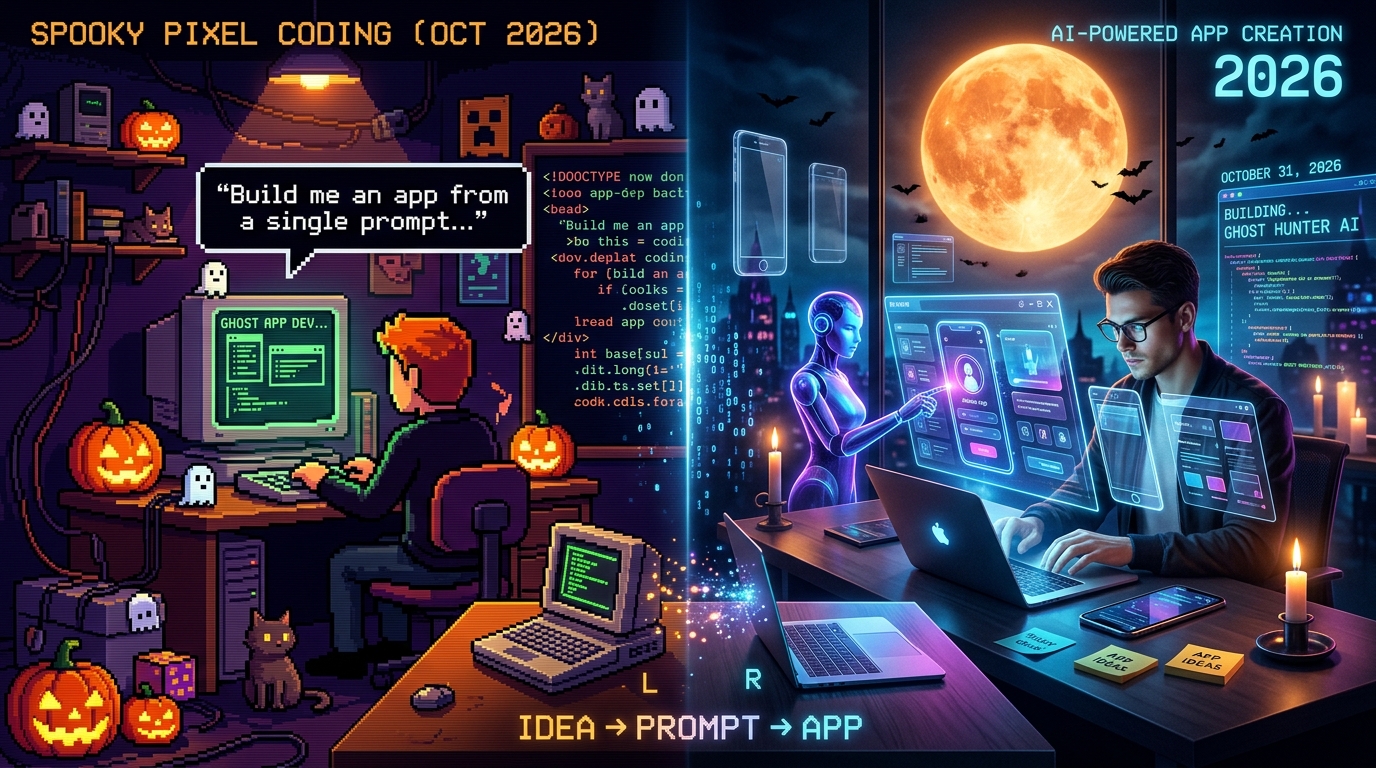
October has arrived, Halloween decorations are everywhere, and apparently AI has decided to bring its own kind of magic trick to the world of app development.
A few years ago, if someone told me, “Just describe the app you want, and AI will build it for you,” I would probably have laughed.
Today, I would still laugh a little.
But then I would open my laptop and try it.
That is probably the strangest part of being around AI in 2026. Things that once sounded like science fiction are slowly becoming part of our everyday development conversations. You can describe an idea in plain English, give AI a prompt, and suddenly you have screens, buttons, layouts, database structures, APIs, and even pieces of working code appearing in front of you.
It feels a little like telling a ghost, “Hey, build me an app,” and watching it come back five minutes later saying, “Done.”
Except… it isn't quite that simple.
The One-Prompt Dream
The idea sounds ridiculously convenient.
Imagine having an app idea but knowing absolutely nothing about coding.
You could type:
“Build me an app where users can find nearby event venues, check availability, view photos, compare prices, and send booking enquiries.”
And instead of staring at a blank screen, AI could generate a starting point.
The interface appears.
The navigation is created.
The login screen exists.
The buttons actually do something.
Suddenly, your random idea has a digital skeleton.
This is where AI has become genuinely interesting to me.
It isn't just answering questions anymore. It can take an idea and turn parts of that idea into something you can actually interact with.
And honestly, watching that happen for the first time feels slightly magical.
Very Halloween appropriate.
But here's where we need to separate magic from marketing.
Because asking AI to build an app and getting a truly production-ready app are two very different things.
So… Can One Prompt Actually Build an App?
Technically?
Yes, in some cases.
Practically?
Not completely.
A single prompt can potentially generate a prototype, basic application structure, UI screens, components, sample data, and even working functionality depending on the tools you're using.
But an actual app is much more than a collection of screens.
There is authentication.
There are databases.
There are APIs.
There are permissions.
There are security concerns.
There are edge cases.
There are devices with different screen sizes.
There are users who will somehow find a button you never knew existed.
And then there is the legendary final boss of every software project:
“It works on my system.”
AI can get you surprisingly far, but someone still needs to understand what has been created.
That part hasn't disappeared.
It has simply changed.
From Coding Everything to Directing the AI
This is probably the biggest shift I've noticed.
Earlier, development often meant starting with:
“What code do I need to write?”
Now, increasingly, the question becomes:
“What exactly do I want this product to do?”
That sounds like a small difference, but it isn't.
When AI can generate code, the ability to clearly explain a product becomes incredibly important.
A vague prompt gives you a vague result.
If I say:
“Build a food delivery app.”
AI has plenty of room to make things up.
But if I say:
“Create a food delivery app where users can browse restaurants within a selected location, filter by cuisine, add items to a cart, choose an address, select a payment method, place an order, and track the order status.”
Now we're giving the AI something much closer to an actual product requirement.
And if I add details about the visual style, user flow, database structure, validation rules, error states, permissions, and expected behaviour?
The result becomes much more useful.
In other words, prompting is slowly becoming part of product thinking.
The Halloween Problem: AI Can Also Create Monsters
Here's the funny part.
AI can build things quickly.
It can also build things wrong very quickly.
And that is where things get interesting.
You might ask AI to create a login screen.
It creates one.
Looks beautiful.
You click the button.
Nothing happens.
Or the button works, but the password isn't actually being validated properly.
Or the database connection is using placeholder credentials.
Or the application accepts an input that it absolutely shouldn't.
Or the UI looks perfect on your laptop but becomes a tiny haunted house on a smaller phone.
Congratulations.
You have created an app monster.
This is why I don't think AI is going to make developers irrelevant overnight.
If anything, it makes good developers more important in a different way.
Someone still needs to inspect what AI produced.
Someone needs to test it.
Someone needs to question it.
Someone needs to notice when the AI confidently creates something that makes absolutely no sense.
And trust me, AI can be very confident while being completely wrong.
The Developer's Role Is Changing
I think the interesting future isn't:
AI vs Developers.
It's more like:
Developers + AI.
AI can handle a lot of repetitive work.
It can generate boilerplate code.
It can suggest components.
It can help convert ideas into prototypes.
It can explain unfamiliar code.
It can find possible bugs.
It can create variations of a UI.
It can even help someone who isn't traditionally a developer get an early version of an idea running.
That is huge.
But software development isn't just typing code.
It's understanding people.
It's understanding business requirements.
It's making decisions.
It's knowing what should happen when something goes wrong.
It's thinking about security.
It's testing weird scenarios.
It's knowing when a shortcut is actually going to become a giant problem six months later.
AI can help with all of these things, but it still needs direction.
And that makes the human role less about typing every single line and more about thinking, deciding, reviewing, and building with intention.
The Part Nobody Talks About: The Prompt Isn't the Product
This is probably the biggest reality check.
You can give AI a brilliant prompt and get an impressive prototype.
But an impressive prototype isn't automatically a successful product.
There is still a massive gap between:
“Look! I built an app!”
and
“People can actually use this app reliably.”
That gap contains testing, refinement, performance optimisation, security, accessibility, real data, backend infrastructure, analytics, deployment, maintenance, updates, and approximately 47 unexpected problems.
Okay, maybe not exactly 47.
But you get the idea.
AI can dramatically reduce the distance between an idea and a prototype.
It doesn't magically remove the distance between a prototype and a great product.
And That's What Excites Me
Personally, I find this shift much more interesting than the idea of AI simply “replacing coding.”
Because imagine someone who has had an app idea sitting in their head for years.
They don't know how to code.
They don't know where to start.
Previously, that idea might have stayed exactly where it was: inside their head.
Now they can describe it.
AI can help them visualise it.
They can experiment.
Change the design.
Add a feature.
Remove another.
Test an idea.
Break it.
Fix it.
Try again.
That lowers the barrier between having an idea and actually building something.
And that is powerful.
So, Is One Prompt Enough?
If the question is:
“Can AI create something that looks and behaves like an app from one prompt?”
Absolutely, depending on the tool and complexity.
If the question is:
“Can I type one sentence and receive a perfect, secure, scalable, production-ready application without doing anything else?”
We're not quite there.
And honestly, I'm not sure we should want that.
Because building an app isn't only about producing code.
It's about making decisions.
It's about understanding users.
It's about solving problems that weren't obvious at the beginning.
It's about looking at something that doesn't work and figuring out why.
AI may be the extremely fast assistant sitting next to the developer, but somebody still needs to hold the flashlight when things get dark.
Especially in October.
Because if there's one thing I've learned from watching AI evolve, it's this:
The scary part isn't that AI can build an app from a prompt.
The scary part is how quickly it's getting better at understanding what we mean.
And somewhere between the first prompt and the final product, the role of the developer is quietly changing.
Maybe the future developer won't spend all day writing code from scratch.
Maybe they'll spend more time describing, designing, testing, questioning, correcting, and directing AI.
And honestly?
I'm curious to see what happens next.
Just hoping my next AI-generated app doesn't come back from the dead with 37 bugs.
Happy Halloween, developers.

Share
|


About Author

Devika
Meet the mind behind the words a faceless force with a signature style. With her bold curls, black frames, and a no-nonsense black tee, she doesn’t need expressions to make an impact-her writing does all the talking. At Skyraan, she turns simple apps into engaging experiences, crafting content that doesn’t just sit there but works, converts, and connects. Every line she writes has a purpose, every word carries weight. She’s not just a content writer she’s the voice that brings the app to life.
Recently posted blogs